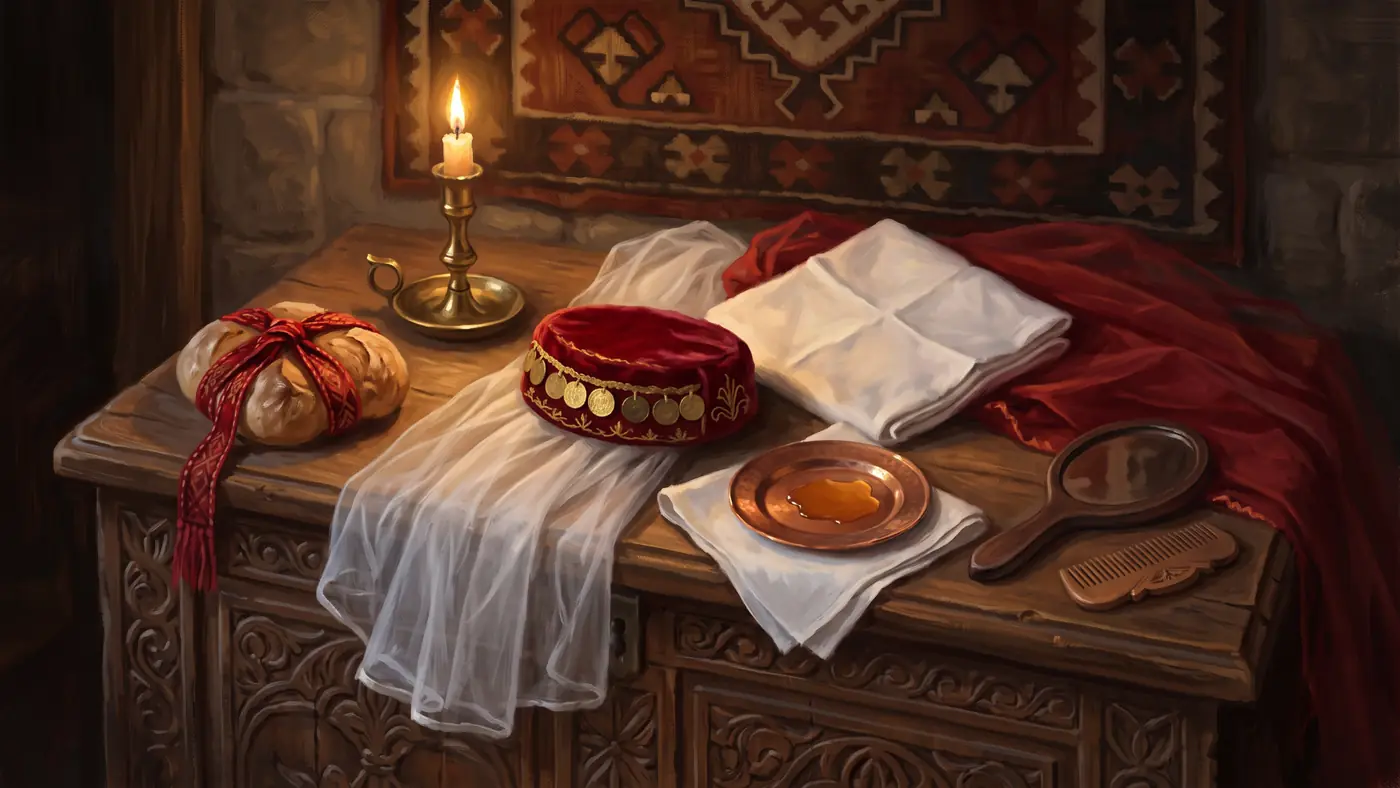
The Ahıska call a wedding not “düğün” but “toy”. Below is the toy as researcher Habibe Kahvecioğlu Sarı recorded it in 2015 among families in Honaz (Denizli, Türkiye). She compared her notes with studies of Ahıska weddings in Kyrgyzstan, Uzbekistan, Kazakhstan, Iğdır and the USA — and found the same customs. Every village and every family has its own shades.
Fetching the bride
After the midday prayer the groom’s father and the yenge (his uncle’s wife) go to the bride’s house with drum and zurna. The groom stays at home and waits. The mother-in-law brings börek, sweets and treats for the hosts.
The yenge dresses the bride:
- katha — a red velvet cap with mahmudiye coins at the front (once gold ones);
- leçeg — a long triangular tulle veil over the katha;
- naznazi — a large white square cloth folded in two;
- on top, a red bridal veil (tuvag), and a small white tulle kerchief over her hands.
A leçeg is not bought: it is inherited — from a mother, an aunt, an elder sister. One bride said hers came from her aunt and she would pass it on to her sister. For a month after the wedding the young wife keeps the katha and leçeg on; then she ties on a lenta — the band of a married woman, worn into old age.
The katha, leçeg and naznazi take up almost no space — which is why they could be carried into exile. They are among the very few old things that have come down to us.
Temenni
Entering among the guests, the bride makes the temenni three times — a greeting of respect: palms at the waist, the right hand rising slowly to the shoulder and back, then the left, knees bending slightly. She makes it all day long, to every elder she sees, eyes lowered.
A cloth is laid under her feet and the yenge puts money on it (in Kyrgyzstan this is called “harç çekmek”). Little girls hold a mirror to the bride, touch her hair with a comb, put henna in her palm — and each gets a coin. Plates of sweets with lit candles are set on the children’s heads and they spin around — this is “çerez oynatma”. The sweets are then given to unmarried girls, so they marry soon. Money is tucked into the bride’s shoes.
The chest that became a suitcase
An elderly woman asks for the girl’s hand; when the family answers “we give her”, the two sides exchange the dowry. In the homeland it was carried in wooden chests; today, in suitcases — so it is recorded both in Honaz and among the Ahıska in the USA.
The bride’s brother wraps a red sash round her three times and takes it off: “The sash is too small, it won’t close!” — until the father-in-law pays. Holding the edge of her red veil, the father-in-law leads her to the car with prayers.
The threshold: a plate and honey
At the groom’s house the bride breaks a plate with her foot — a test of her strength. The groom’s sister waits with a plate of honey; with her right hand the bride smears honey on the door three times — so that things between them stay sweet. A small child is set on her lap — for children to come. At the table the elder men of the family take turns giving blessings.
The wedding and the tamada
The evening is run by the tamada — he makes speeches, calls the elders to speak, sings mani, explains each custom to the guests. According to Dervisheva, the custom of the tamada came to the Ahıska from the Georgians — a memory of neighbourhood.
The yenges tie two loaves baked by the mother-in-law to the bride’s waist — “so she brings plenty”. After the wedding the groom and his friends eat that bread. Rice is poured into the bride’s palms; she scatters it as she makes temenni.
One of the recorded mani:
Bahçen bağ olsun gelin, yüzün al olsun gelin (May your garden be a vineyard, bride; may your face be rosy, bride)
A joking rite with the best man: he dances with two ribboned knives and asks the guests, “What shall we cut off the bride — her tongue or her head?” Everyone shouts “Her tongue!” — meaning: may she be quiet and respectful before the elders. With a knife he lifts the red veil three times and lays it on the mother-in-law’s chair, and she sits on it. The groom gives the bride money “for seeing her face” and lifts her veil — the first dance begins.
Bar
The wedding dances are the “girls’ bar” and the “men’s bar”. According to Dervisheva, until 1944 people in Ahıska said “halay”; after the deportation they began to say “bar” and “bar oynamah”.
Your wedding
This is the wedding of one place and one year. If it was different in your family — what the veil was called, who ran the wedding, what was sung — record your elders in Voices. This is how a people’s real customs are gathered: one family at a time.