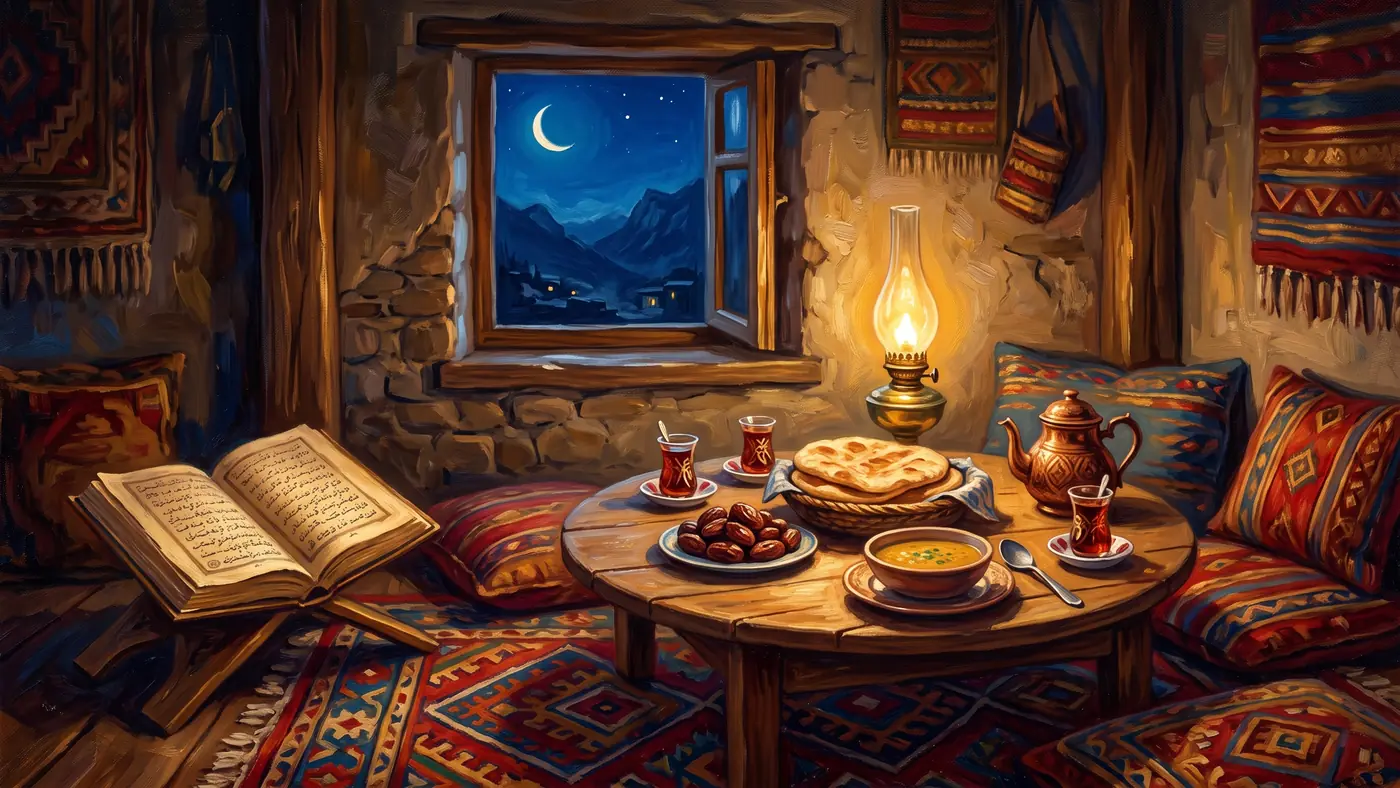
For the Ahıska, Ramadan is not only a fast but a month that is sung. In 1994 the folklorist Asif Hacılı and Habib İdrisi described how it was welcomed and seen off. In 2022 researchers Murat Karabulut and Berkay Gençer interviewed Ahıska families in north-eastern Türkiye and confirmed that these customs are alive.
Iftar — every evening in a different house
On every evening of the fast people gather “to open the iftar” in one of the houses — a different one each time. At the table there is general conversation, difficult matters are settled, prayers are said.
The first fifteen days — “Merhaba”
In the first half of the month people sing the “Merhaba” kasides — a greeting to Ramadan, as to a dear guest:
Mübarek ramazan geldı, mescitler nurla doldı… Merhaba, ay şehr-i ramazan, merhaba. (Blessed Ramadan has come, the mosques are filled with light… Welcome, month of Ramadan, welcome.)
The last fifteen — “Elveda”
In the second half the month is seen off — “Elveda”, “farewell”. In these hymns Ramadan itself says goodbye to those who honoured it and listened to the ilahis.
Bayram
The Ahıska call Ramadan Bayram their most beloved holiday: people gather, read poems and prayers, sing and dance. And according to Hacılı and İdrisi, the whole year is adorned by Nowruz, New Year, Hıdırellez, mevlid, Rajab, Kurban, Ashura — and evenings of songs and tales (see Evenings of tales). Holiday dates are in the calendar.
Your family
If your grandmother or grandfather remembers “Merhaba” or “Elveda”, record them in Voices. The words can be found in books, but only a voice recording keeps the tune.
Sources
- Hacılı A., İdrisi H. H. «Ahıska Türklerinin örf ve âdetleri», Atatürk Üniversitesi Türkiyat Araştırmaları Enstitüsü Dergisi (1994) — по цитатам у Карабулута и Генчера
- Karabulut M., Gençer B. «Türkiye’de yaşayan Ahıska Türklerinin halk müziği kültürleri üzerine bir inceleme», ZfWT 14/2 (2022), с. 131–154