A headdress in three parts
The heart of Ahıska women’s dress is the headdress the women themselves call katha-leçek (in some places papah-leçek). It is made of three pieces worn one over the other.
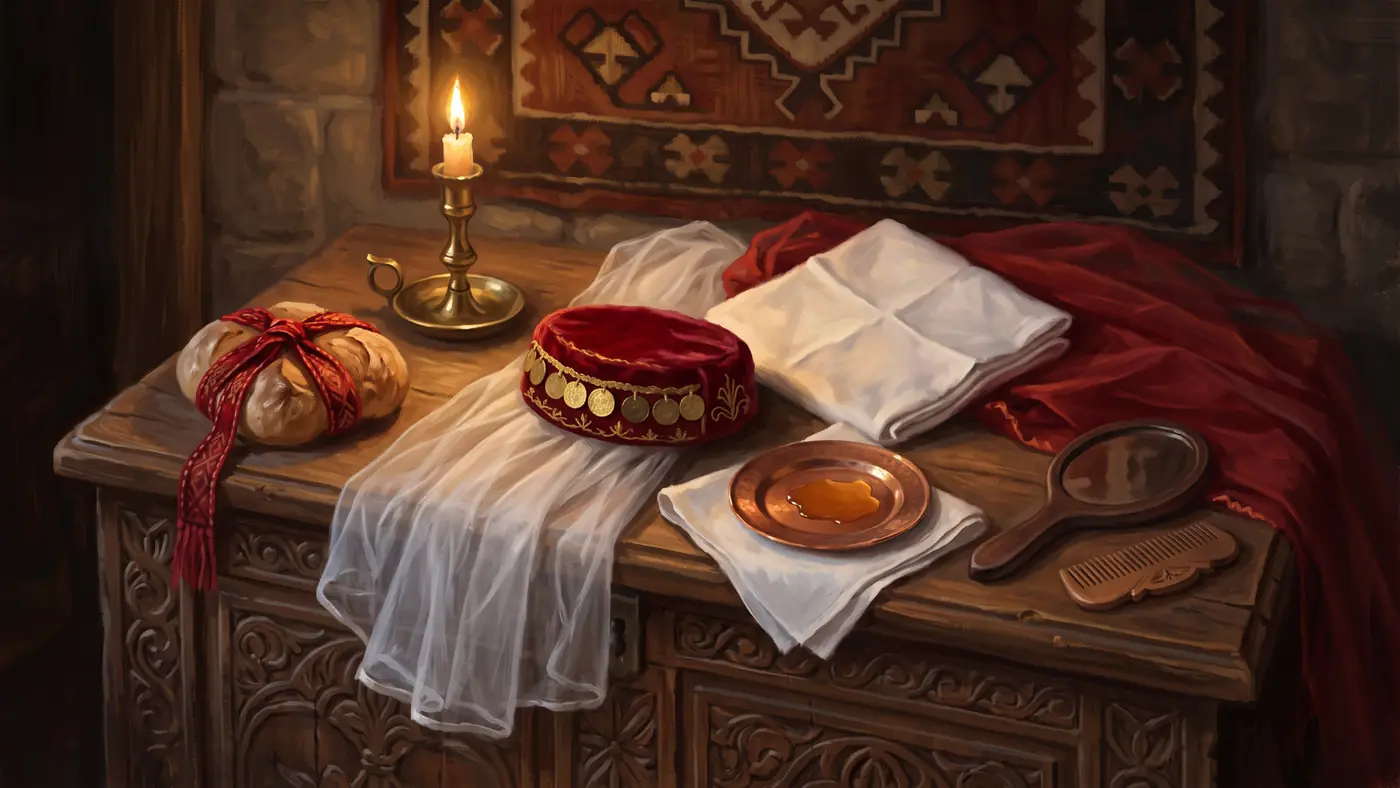
The katha is a low, stiff cap. Before the deportation its frame was made from the wooden rim of a sieve; afterwards, from cardboard. It is covered with pomegranate-red velvet. The velvet is no accident: it is festive and not slippery, so the veil does not slide off. On each side there is a loop and a cord with a bead: it passes under the chin so the cap does not fall off during work.
Gold is sewn onto the katha. Right above the forehead sits a large Mahmudiye coin (an Ottoman coin of Sultan Mahmud II) — one or three. Around and above it run one or two rows of small coins, urbiya (elsewhere pipanur), sometimes a “flower” of coins, punpuli.
The leçek is a plain white veil without embroidery, of fine mermerşahi cloth, about one and a half metres square, with needle lace along the edge. It is wrapped so as to cover the neck, and tied or pinned with a brooch.
The vala (also kalağa, kelağayi; the general word is tavşal) is a silk shawl of the same size with a printed buta pattern. These shawls were made in Azerbaijan. The vala is folded into a triangle, thrown over and not tied. Today the favourite is white with a purple border.
Who wore it, and when
- A bride put on the katha-leçek as she left her father’s house.
- A young married woman before the deportation wore it until about the age of 30. After the deportation the time grew shorter: a year or two, then a few months, then only for visits.
- Today only a bride wears the katha-leçek — at the matchmaking, the engagement, the wedding and on “hinkal day”, one to three times in her life. It is still worn at weddings now.
- A middle-aged woman no longer wore the katha: over the leçek went a dark tavşal of cotton or wool.
- An old woman wrapped her head in the leçek and covered it with a tavşal — thrown over, not tied; at work she wound it round her neck and tied it loosely at the back.
Why our grandmothers wore Pavlovo Posad shawls
After the deportation there was no way to get their own shawls. Women took what was at hand and looked like theirs: the “Japanese shawl”, the Pavlovo Posad shawl, the “Russian scarf”. Later, kelağayi began to be brought from Azerbaijan again. So the flowered shawls with roses in old photographs from Central Asia are not a mistake — they are a trace of the road.
Dress and jewellery
Before 1944 a woman wore an undershirt (içlik), trousers (dambal), a dress or a skirt with a shirt, an apron (peştamal), a sash (kuşak; for festive wear a silver kemer), a waistcoat and çarık. There were several aprons, each with its own job: a cotton one for the house, a black one for milking.
No one knows exactly what a wedding dress looked like before 1944: there are no photographs. According to the elders it was called “üçetek” — “three skirts”. The elders name its colour differently: red, green, purple — or white, scarlet, green.
Jewellery included a necklace with a “Hungarian gold coin” and beads of amber or oltu stone (şöve), and round gold earrings.
Men
Before the deportation men wore Caucasian dress: on the head a fez, a papakha or a turban of coloured cloth; a shirt of striped homespun, a quilted zubun waistcoat, trousers with braid embroidery, and on the feet mostly çarık with woollen socks. Aghas and beys wore the çoha with cartridge pockets. After the deportation the Kazakhs called the Ahıska in their çarıks “çokay”.
How our headdress differs from the neighbours’
The researcher compared the Ahıska headdress with Georgian, Armenian, Crimean Tatar, Bosnian and Anatolian ones. Her conclusion: after the deportation Ahıska dress is close to Caucasian dress, but the headdress is closer to Anatolia and Bosnia, and very different from the Georgian and Armenian ones. So a “generic Caucasian” women’s costume is wrong for the Ahıska.
What we do not know yet
There are no sources on how dress differed between districts — Adigön, Aspinza, Ahılkelek. No one has described children’s clothing before the deportation. If your family keeps a katha, a leçek or an old photograph of someone wearing them, it is part of our shared memory.