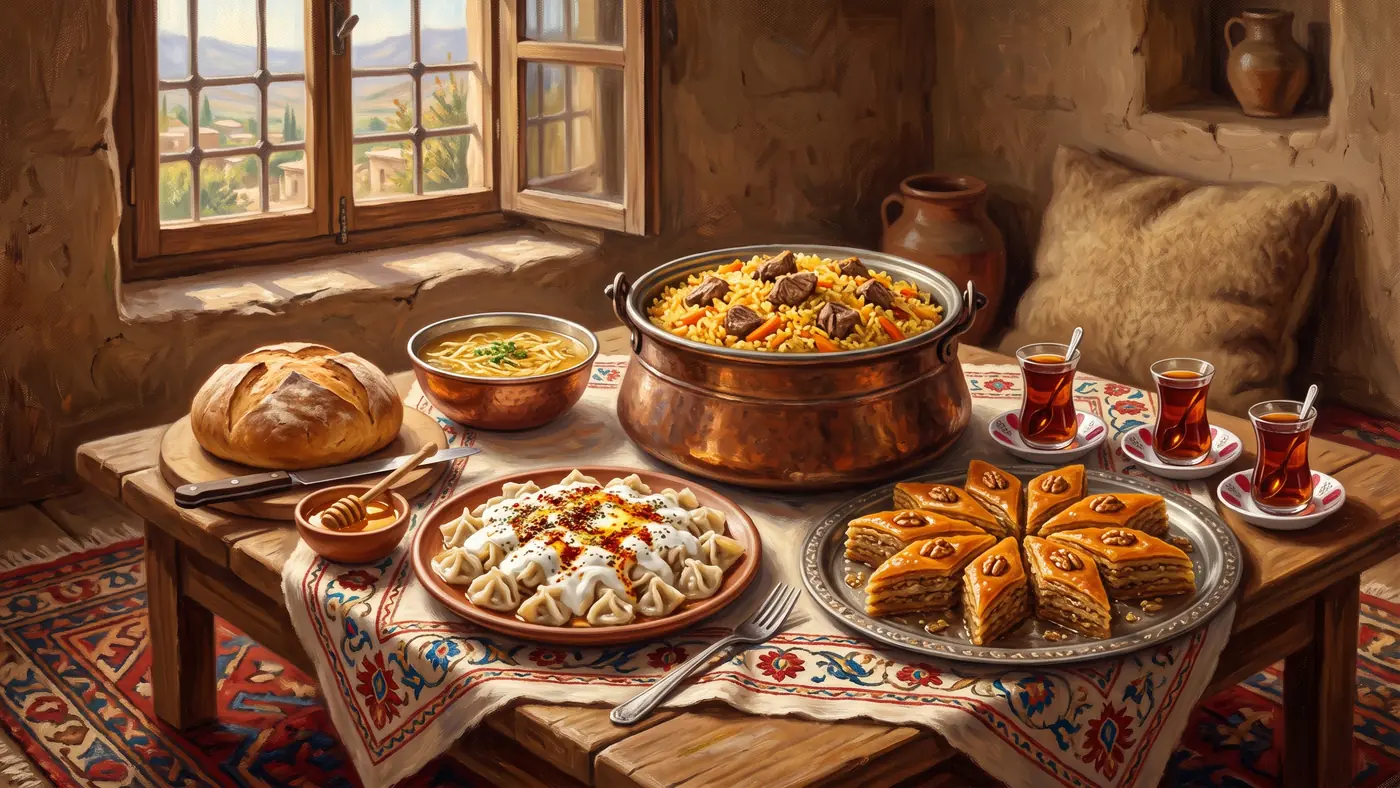
The Ahıska table is like the people themselves: the whole road shows on it. Some of it came from the Caucasus, some from Central Asia. There are no recipes here: recipes must be recorded from the women who cook them, not invented. Here is what is known about our cuisine from verifiable sources.
The Caucasus
The ethnographers Panesh and Ermolov wrote in 1990 that Ahıska culture is close to Turkish culture, but that Georgian influence is clearly visible in it — in clothing, housing and food.
According to Ahıska families in Ukraine, the table may hold “inkal” — the Ahıska name for khinkali: a boiled pouch of dough with minced meat and broth inside, only smaller than the Georgian kind.
In Üzümlü (Erzincan) Ahıska women serve hengel — a dish that in Türkiye is called manti. A similar hingel is associated in Türkiye above all with Ardahan and Posof, Ahıska’s neighbours across the border.
Central Asia
Nearly half a century of life in Uzbekistan, Kazakhstan and Kyrgyzstan changed the cuisine. Ethnographers observed that the Ahıska borrowed some elements of dress, cuisine and home layout from their neighbours, but kept their festive cuisine and its ingredients as symbols of their culture.
The main dish from Central Asia is pilaf (plov). In Ahıska families in Ukraine it is cooked for Kurban Bayram: lamb is browned in a cauldron with onion and carrots, rice and water are added and it simmers over a low fire. In Üzümlü Uzbek pilaf takes about three and a half hours. Steamed manti and baked filled buns are made too.
The table on the great days
- Weddings. The mother-in-law brings börek and sweets to the bride’s house; the yenge lays out her treats, “the yenge’s çerez”. Two loaves baked by the mother-in-law are tied to the bride’s waist, and at the threshold the bride smears honey on the door. At the groom’s house guests are fed from big cauldrons (details in “Toy: the Ahıska wedding”). At a big wedding, families in Ukraine say, the whole village helps: the men cook the main dish, the pilaf, the women make salads and the rest.
- Funerals. Baklava is baked for the memorial meal.
- Kurban Bayram. The sacrificial meat is not given only to Muslims: in Ukraine it also goes to Ukrainian neighbours and to a boarding school.
- Ramadan. Every evening of the fast, iftar in a different house (“Ramadan: ‘Merhaba’ and ‘Elveda’”).
Today
In September 2025 Ahıska women from Üzümlü presented their dishes in Erzincan: hengel, Uzbek pilaf, tutmaç soup and “Uzbek medovik” honey cake. It was decided to sell the dishes twice a week. A table that survived two exiles now feeds its neighbours too.
Your family
How did your grandmother make hengel? What was baked for a wedding, what was set on the memorial table? Record her telling in Voices — with her words, her hands, her measures “by eye”. A true Ahıska cookbook can only grow this way: from families.
Sources
- Панеш Э. Х., Ермолов Л. Б. «Турки-месхетинцы (историко-этнографический анализ проблемы)», Советская этнография, 1990, № 1
- Encyclopedia of World Cultures — «Meskhetians» (Gale; everyculture.com)
- Ukraїner — «The Meskhetian Turks of Ukraine. Who are they?» (2019)
- Kahvecioğlu Sarı H. «Honaz’da yaşayan Ahıska Türklerinin düğün törenleri üzerine bir araştırma», SOBİDER 4/13 (2017)
- Bengütürk — «Ahıska Türklerinin yöresel lezzetleri Erzincan’da tanıtıldı» (11.09.2025)
- Wikipedia — «Hingel»