The Keeper is a helper, not an archive: it can be wrong. Check important family facts with elders and documents.
Weather in Ahıska this weekAkhaltsikhe, Georgia · Ahıska time
Looking out the window…
CalendarPeople’s dates, the Meclis and your own people’s birthdays
House radioSaz, ney, instrumental
One music for the whole home—
Record an elder’s first voice — and the radio will join the records. Near a voice recording and at the Meclis the music falls silent by itself, or it would get into the recording. While a film plays, too.
Make it yoursEach item is about something that really gets in the way
Text size
Sound
Language
You are a guest — everything living here is an example.You are a guest: everything living here comes from an example home; its people are invented. Join the club — the real one opens.
What our people wrote and published — and what was written about them. Everything with a source; where there is a scan, a link to it.
37
records in the library
Where we begin
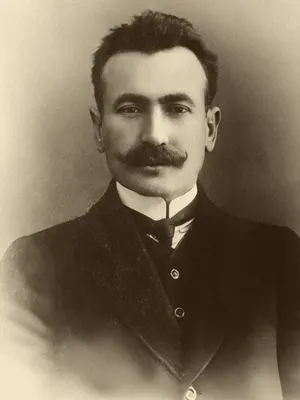
Ömer Faik Nemanzade
Born on 24 December 1872 in the village of Azgur near Ahıska. An enlightener, journalist and publisher: owner of the “Geyret” press and one of the founders of the satirical magazine “Molla Nasreddin” (Tiflis, 1906), read from Istanbul to Tabriz. Shot on 10 October 1937 in Tbilisi. We gather his articles, books and the newspapers he worked with here first — each record with its source.
Do you know where his writings are kept, or do you have old newspapers or books by our authors at home? Tell us — we will check and add them.
Books18
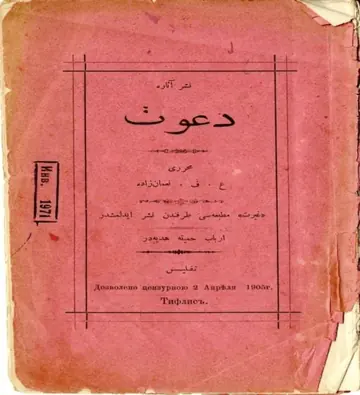
“Nəşri-asarə dəvət” (“An invitation to publish works”)
Ömer Faik Nemanzade1905Tiflis, “Geyrat” pressAzerbaijani Turkic, Arabic script
In short
Ömer Faik’s first book: the censor approved it on 2 April 1905.
It came out at his “Geyrat” press in Tiflis — the one that would start printing “Molla Nasreddin” a year later.
A full scan of all 36 pages can be read on the site of his archive.
More
A 36-page booklet, published in April 1905. According to its modern editor Shirmammad Huseynov, it is one of the first works on the history of printing and the press in Azerbaijan. The original is kept at the Institute of Manuscripts of ANAS; a full scan is on omarfaig.info.
Source: Azerbaijani Wikipedia, article “Ömər Faiq Nemanzadə” (“Əsərləri”); omarfaig.info, page “Nəşri-Asarə Dəvət” (Sh. Huseynov’s preface and scan). Cover: The 1905 cover, stamped “Permitted by the censor, 2 April 1905”. Public domain; scan — omarfaig.info
“Bizə hansı elmlər lazımdır” (“What sciences do we need”)
“Bizə hansı elmlər lazımdır” (“What sciences do we need”)
A collection; its authors include Ömer Faik Nemanzade, Akhund Abuturab, Ali bey Huseynzade1907Tiflis, “Geyrat” pressAzerbaijani Turkic, Arabic script
In short
Not a single book but a debate in print: several authors answer the question “What sciences do we need?”.
Among them are Ömer Faik with “Nemanzade’s answer” and Ali bey Huseynzade.
Published in 1907 by “Geyrat”; the original is at the Institute of Manuscripts in Baku.
More
A collection of different authors’ answers to the question in its title — 47 pages. Ömer Faik’s part is called “Nemanzade’s answer”. The original is kept at the Institute of Manuscripts of ANAS.
Ömer Faik Nemanzadewritten after 1927; published in 1985Baku, “Ganjlik” (edited by Shamil Gurbanov)Azerbaijani
In short
Memories of the press and the people of the early 20th century — Ömer Faik wrote them in retirement, after 1927.
He never finished: in the summer of 1937 he was arrested in Akhaltsikhe and shot in October.
The manuscript survived; the book came out in Baku in 1985 and was reissued in 2014.
More
Memoirs Ömer Faik worked on after retiring in 1927 and never finished: in the summer of 1937 he was arrested in Akhaltsikhe. The manuscript is kept at the Institute of Manuscripts of ANAS; Shamil Gurbanov prepared it for print (Baku, 1985, 124 pp.), and it was reissued in 2014.
“Ahıska Bölgesi ve Ahıska Türkleri” (“The Ahıska region and the Ahıska Turks”)
“Ahıska Bölgesi ve Ahıska Türkleri” (“The Ahıska region and the Ahıska Turks”)
Yunus Zeyrek2001AnkaraTurkish
In short
An overview of the land of Ahıska and its people, published in Ankara in 2001.
The author teaches at Gazi University and has published the journal “Bizim Ahıska” since 2004.
Turkish researchers often cite it when writing about the region.
More
An overview of the land of Ahıska and its people. The author teaches at Gazi University in Ankara and edits the journal “Bizim Ahıska”.
Source: Catalogue data (1000kitap.com: Pozitif Matbaacılık, Ankara, 2001); the site of the journal “Bizim Ahıska” (ahiska.org.tr).
“Osmanlılar’ın Kafkas-Elleri’ni Fethi (1451–1590)” (“The Ottoman conquest of the Caucasian lands”)
“Osmanlılar’ın Kafkas-Elleri’ni Fethi (1451–1590)” (“The Ottoman conquest of the Caucasian lands”)
M. Fahrettin Kırzıoğlu (1917–2005)1975ErzurumTurkish
In short
The history of the Ottoman advance into the Caucasus in 1451–1590.
In these years, in 1578, the land of Ahıska also passed to the Ottomans — see our article “Ahıska: the history of the land up to 1829”.
The author came from a village near Kars; the book is his 1967 doctoral thesis.
More
A 1967 doctoral thesis, published as a book in Erzurum in 1975: the history of Ottoman campaigns in the Caucasus in 1451–1590. These years include 1578, when the land of Ahıska became part of the Ottoman state.
Source: TDV İslâm Ansiklopedisi, article “Kırzıoğlu, Mehmet Fahrettin” (S. Esin Dayı).
“Ahıska Türk Folkloru” (“Ahıska Turkish folklore”)
“Ahıska Türk Folkloru” (“Ahıska Turkish folklore”)
Asif HacılıTurkish
In short
A collection of Ahıska Turkish folklore: proverbs, songs, tales, lives of the ashiks.
All 719 proverbs in our Proverbs section come from this book.
A proverb is translated only where a native speaker has checked it.
More
A collection of Ahıska Turkish folklore: proverbs, songs, tales, lives of the ashiks. Published by the Atatürk Cultural Centre. The 719 proverbs of our Proverbs section come from it (in Ahıska Lingo transliteration). Year of publication being checked.
Source: “Azerbaijan” University (au.edu.az) — news on Prof. Asif Hajiyev’s books; the Ahıska Lingo proverb corpus.
“Üçüncü il” (“The third year”)
“Üçüncü il” (“The third year”)
Ömer Faik Nemanzade, H. G. Sanili, H. Akhundov1927Baku, “Azarnashr”Azerbaijani
In short
A book for schoolchildren: short stories to read in class.
In the Soviet years Ömer Faik worked a great deal on schoolbooks — this is one of them.
It was reissued four years running, from 1927 to 1930.
More
A school book of short stories for children, written by three authors. Reissued and expanded in 1928, 1929 and 1930.
“Qəribəm bu vətəndə” (“I am a stranger in this land”)
“Qəribəm bu vətəndə” (“I am a stranger in this land”)
Asif Hacılı1992Baku, “Ganjlik”Azerbaijani
In short
Hacılı’s book on Ahıska culture — with texts recorded from the elders.
Legends, tales, ashik dastans, stories of the old life.
His 2022 article draws on it — the main source of our articles “Ashiks” and “Evenings of tales”.
More
Subtitled “The ethnic culture of the Ahıska Turks”. It gathers oral texts the author recorded among the Ahıska: legends, tales, fragments of dastans, stories of the old life. Hacılı cites it constantly in his later work.
Source: Bibliography in A. Hacılı’s article (Uluslararası Ahıska Araştırmaları Dergisi, 2022, Zenodo).
“Ahıska Türkləri: vətən bilgisi” (“Knowledge of the homeland”)
“Ahıska Türkləri: vətən bilgisi” (“Knowledge of the homeland”)
Asif Hacılı2009ARTA publishingAzerbaijani
In short
“Vətən bilgisi” — “knowledge of the homeland”: a book on the land of Ahıska.
The author is a folklorist who has recorded Ahıska memory since the 1980s.
More
Asif Hacılı’s book on the Ahıska homeland; the title means “knowledge of the homeland”. We have seen it only in bibliographies — if you have it at home, tell us what is inside.
Source: Bibliography in A. Hacılı’s article (Uluslararası Ahıska Araştırmaları Dergisi, 2022, Zenodo).
“Axısqa türklərinin sürgün folkloru” (“The folklore of exile”)
“Axısqa türklərinin sürgün folkloru” (“The folklore of exile”)
Asif Hacılı2014Baku, “Mutarjim”Azerbaijani
In short
How song, tale and legend survived exile — the subject of the whole book.
In brief — the author’s 2022 article and our article “Evenings of tales”.
More
A book on Ahıska folklore in exile. On the same theme is the author’s 2022 article (below, under “Articles and studies”): how folklore kept the people together when there was neither land nor schooling in their own language.
Source: Bibliography in A. Hacılı’s article (Uluslararası Ahıska Araştırmaları Dergisi, 2022, Zenodo).
“Ahıska türkləri: inanc dünyası” (“The world of beliefs”)
“Ahıska türkləri: inanc dünyası” (“The world of beliefs”)
Asif Hacılı2014Baku, “Mutarjim”Azerbaijani
In short
“İnanc dünyası” — “the world of beliefs”: a book on Ahıska folk faith.
We have seen it only in bibliographies — if you have it, tell us.
More
A book on Ahıska folk beliefs. Some of its themes — the saintly dedes, the Al arvadı spirit — Hacılı also discusses in his 2022 article.
Source: Bibliography in A. Hacılı’s article (Uluslararası Ahıska Araştırmaları Dergisi, 2022, Zenodo).
“Ata yurdum Ahıska” (“Ahıska, my fathers’ land”)
“Ata yurdum Ahıska” (“Ahıska, my fathers’ land”)
A. Piriyev, S. Piriyeva2001Baku, “Mutarjim”Azerbaijani
In short
A book of memory about the Ahıska land.
Listed among the sources on Ahıska folklore in Hacılı’s work.
More
A book on the Ahıska homeland, published in Baku. Asif Hacılı lists it among the sources on Ahıska folklore.
Source: Bibliography in A. Hacılı’s article (Uluslararası Ahıska Araştırmaları Dergisi, 2022, Zenodo).
“Baba ocağı – ana sıcağı” (“Father’s hearth, mother’s warmth”)
“Baba ocağı – ana sıcağı” (“Father’s hearth, mother’s warmth”)
N. Sasiyev2007Baku, “Mutarjim”Azerbaijani
In short
A collection of Ahıska Turkish folklore — so Hacılı’s bibliography describes it.
The title is a saying about home: father’s hearth, mother’s warmth.
More
A collection of Ahıska Turkish folklore.
Source: Bibliography in A. Hacılı’s article (Uluslararası Ahıska Araştırmaları Dergisi, 2022, Zenodo).
“Iosif Stalin to Lavrentiy Beria: ‘They must be deported…’”
“Iosif Stalin to Lavrentiy Beria: ‘They must be deported…’”
Compiled by N. F. Bugai1992Moscow, “Druzhba narodov”Russian
In short
A collection of documents on the deportations of the peoples of the USSR, published in 1992 as the archives began to open.
Orders, reports, memoranda — the voice of the state itself, unretold.
Compiled by historian Nikolai Bugai, who also wrote a book on the Turks of Meskhetia.
More
Documents, facts, commentary — 286 pages. A collection of declassified documents on the deportations of the peoples of the USSR.
Source: Bibliography in P. Polian’s “Ne po svoei vole…” (Moscow, 2001; full text — demoscope.ru).
“Turks from Meskhetia: the long road to rehabilitation (1944–1994)”
“Turks from Meskhetia: the long road to rehabilitation (1944–1994)”
N. F. Bugai1994Moscow, “ROSS” publishing houseRussian
In short
A book devoted entirely to the fate of our people after 1944.
Fifty years — from the trains to 1994.
By the historian who also compiled the collection of deportation documents (above).
More
A book by historian Nikolai Bugai — 162 pages on the fifty years after the deportation and the people’s long road to rehabilitation.
Source: Bibliography in P. Polian’s “Ne po svoei vole…” (Moscow, 2001; full text — demoscope.ru).
“Not of their own will… A history and geography of forced migrations in the USSR”
“Not of their own will… A history and geography of forced migrations in the USSR”
Pavel Polian2001Moscow, OGI — MemorialRussian
In short
All the deportations of the USSR in one book: who, when, from where to where — with maps.
Our people are among those not allowed to return; there is a chapter on them.
It can be read in full, free — on the “Demoscope” site.
More
The main reference work on all the deportations in the USSR — 328 pages, with maps and tables. It has a separate chapter, “The rehabilitation of the Meskhetian Turks”. The full text is on the “Demoscope” site.
Source: The book itself (title page and contents), demoscope.ru.
“The Meskhetian Turks at a Crossroads: Integration, Repatriation or Resettlement?”
“The Meskhetian Turks at a Crossroads: Integration, Repatriation or Resettlement?”
Edited by Tom Trier and Andrei Khanzhin2007Münster, LIT Verlag; Russian edition — St PetersburgEnglish; also in Russian
In short
A major study of our people — 663 pages, research in every country where the Ahıska live.
The questions every family asks: where is our home, where do we want to be.
Available in English and in Russian.
More
The result of the European Centre for Minority Issues (ECMI) research project of 2004–2006 — 663 pages. How the Ahıska live in each country, what “home” means to them and whether they wish to return. Also published in Russian.
“Meskhetian Turks: An Introduction to their History, Culture and Resettlement Experiences”
“Meskhetian Turks: An Introduction to their History, Culture and Resettlement Experiences”
Ayşegül Aydıngün et al.2006Washington, Center for Applied LinguisticsEnglish
In short
How to explain to America who the Ahıska are — a short book for new neighbours.
Lead author — sociologist Ayşegül Aydıngün, who has studied our people all her life.
A good gift for your children’s teacher in the USA.
More
An introduction for those who welcomed the Ahıska in the USA when thousands of families resettled there in 2004–2006: history, culture, family, customs.
Source: OpenMETU catalogue (Middle East Technical University); MENAdoc, Halle University library.
Newspapers6
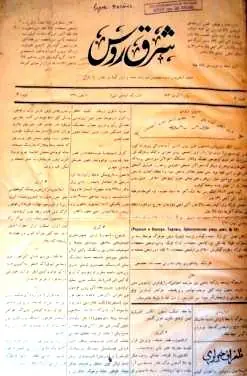
“Şərqi-Rus” (“The Russian East”)
Publisher and editor-in-chief — Mammad agha Shahtakhtinsky1903–1905TiflisAzerbaijani Turkic, Arabic script
In short
The first Turkic-language newspaper in Tiflis in twelve years — since “Kashkul” closed in 1891; it came out three times a week.
Ömer Faik published notes headed “Ahıska” here (1903, 1904).
Jalil Mammadguluzadeh worked here too; when the paper closed, the two of them bought its press and named it “Geyrat”.
More
A socio-political and literary newspaper (12 April 1903 — 28 January 1905). Jalil Mammadguluzadeh worked here as an editor, and Ömer Faik Nemanzade was among its authors: the two future founders of “Molla Nasreddin”.
Source: Azerbaijani Wikipedia, article “Şərqi-rus (qəzet)”; omarfaig.info — “Kitab, qəzet, jurnal siyahısı”. Cover: An issue of the newspaper, 1903–1905. Public domain; scan — Archive of Socio-Political Documents (Baku), Wikimedia Commons
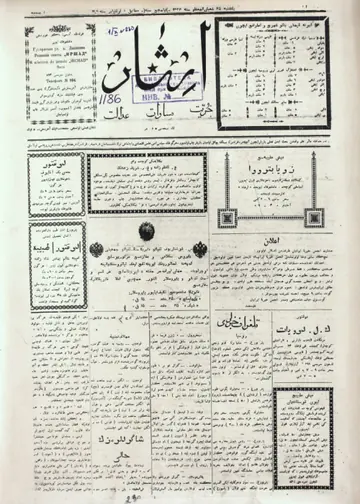
“İrşad” (“Guidance”)
Publisher — Ahmed bey Agaoglu1905–1908BakuAzerbaijani Turkic, Arabic script
In short
A Baku daily started in December 1905, when the tsar’s manifesto promised freedom of the press.
Its publisher was Ahmed bey Agaoglu; its best-known satirist was Uzeyir Hajibeyov.
Closed twice for its satire — temporarily in 1907, for good in 1908.
More
A Baku newspaper Ömer Faik Nemanzade wrote for.
Source: Azerbaijani Wikipedia, articles “İrşad (qəzet)” and “Ömər Faiq Nemanzadə”. Cover: An issue of the newspaper, 1906. Scan — Archive of Socio-Political Documents (Baku); Wikimedia Commons, CC BY-SA 4.0
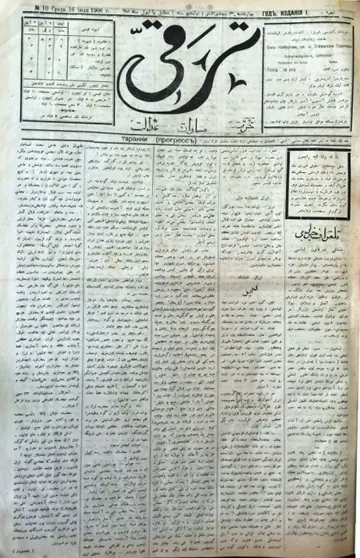
“Tərəqqi” (“Progress”)
Editor-in-chief — Ahmed bey Agaoglu1908–1909BakuAzerbaijani Turkic, Arabic script
In short
The first issue came out on 8 June 1908; under the title stood “Liberty, equality, justice”.
Rasulzade called it the first European-style newspaper in Azerbaijan.
Its authors included Ömer Faik, Uzeyir Hajibeyov and Ali bey Huseynzade; Gogol’s “The Overcoat” first appeared here in Hajibeyov’s translation.
More
A Baku newspaper Ömer Faik Nemanzade wrote for.
Source: Azerbaijani Wikipedia, articles “Tərəqqi (qəzet)” and “Ömər Faiq Nemanzadə”. Cover: The issue of 16 July 1908. Scan — Archive of Socio-Political Documents (Baku); Wikimedia Commons, CC BY-SA 4.0
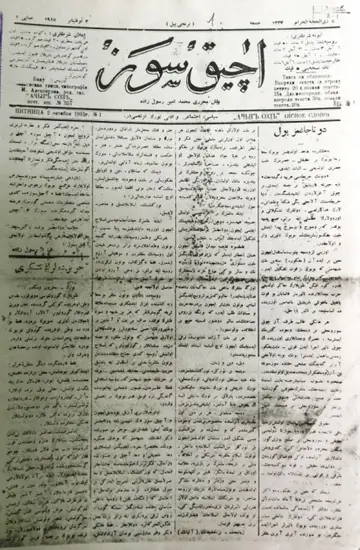
A Baku daily; the first issue appeared on 2 October 1915.
It was in this paper that the people were first called “Turks” — instead of “Muslims” and “Tatars”.
Ömer Faik was among its authors; its editors at different times included Rasulzade and Uzeyir Hajibeyov.
More
A Baku newspaper Ömer Faik Nemanzade wrote for.
Source: Azerbaijani Wikipedia, articles “Açıq söz (qəzet)” and “Ömər Faiq Nemanzadə”. Cover: The first issue, 2 October 1915. Public domain; scan — Archive of Socio-Political Documents (Baku), Wikimedia Commons
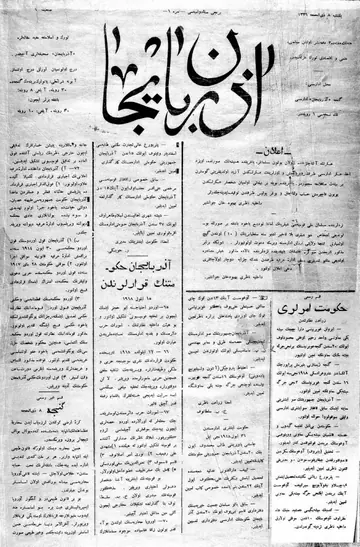
Source: Azerbaijani Wikipedia, article “Azərbaycan (qəzet, 1918)”; omarfaig.info, section “Azərbaycan” articles. Cover: The first issue, 15 September 1918. Public domain, Wikimedia Commons
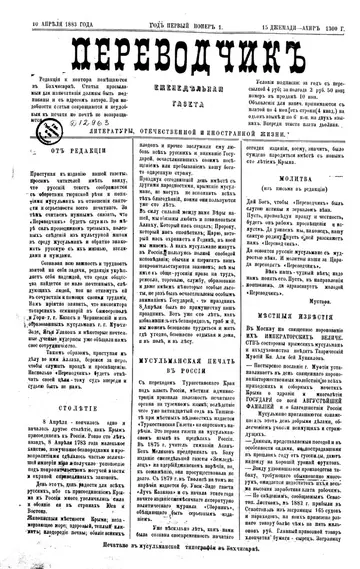
Ismail Gasprinsky’s paper from Bakhchysarai — read by Turks across the empire for 35 years.
In 1900 Ömer Faik’s note “From Ahıska” appeared here.
A link between two peoples deported in 1944: the Crimean Tatars and the Ahıska.
More
The main newspaper of the Turks of the Russian Empire, published in Crimea by the enlightener Ismail Gasprinsky. Young Ömer Faik published his notes “From Sheki” (1898) and “From Ahıska” (1900) in it.
Source: Wikipedia, “Terciman” and “Tərcüman (qəzet)”; omarfaig.info — bibliography. Cover: The first issue, 10 April 1883. Public domain, Wikimedia Commons
Magazines3
Molla Nasreddin
Jalil Mammadguluzadeh, Ömer Faik Nemanzade and others1906–1931Tiflis → Tabriz → BakuAzerbaijani Turkic, Arabic script
In short
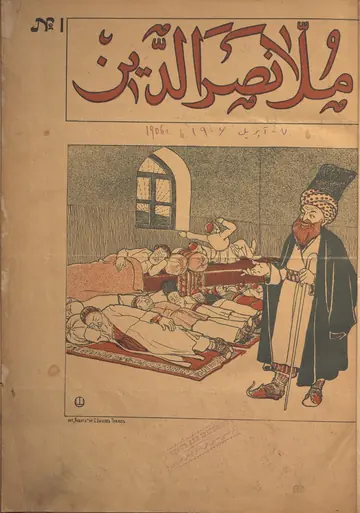
Founded in Tiflis in 1906 by Jalil Mammadguluzadeh and Ömer Faik from Ahıska; printed at their “Geyrat” press.
Half of every issue was drawings, so that even the illiterate could understand.
Published in Tiflis, Tabriz and Baku until 1931; every issue is on mnjurnal.az.
More
A satirical magazine founded in Tiflis in 1906. Ömer Faik Nemanzade, born in Ahıska, was one of its founders: it was printed at his “Geyrat” press. It laughed at ignorance, superstition and tyranny — and so was read from Istanbul to Tabriz.
Source: Fuzuli Institute of Manuscripts, ANAS — archive of every issue (mnjurnal.az); National Library of Azerbaijan — “Molla Nasreddin 120” exhibition; Wikipedia, “Molla Nasraddin (magazine)”. Cover: The first issue, 1906. Public domain, Wikimedia Commons
“Bizim Ahıska” (“Our Ahıska”)
“Bizim Ahıska” (“Our Ahıska”)
Editor — Yunus Zeyreksince 2004AnkaraTurkish
In short
The Ahıska journal in Türkiye — since 2004.
Regional history, elders’ memories, community news.
Edited by Yunus Zeyrek, author of “Ahıska Bölgesi ve Ahıska Türkleri”.
More
A seasonal journal on Ahıska history and culture. Both scholars and the Ahıska themselves write in it — for example Asif Hacılı’s “Ahıska in memories” (2011).
Source: The journal’s site (ahiska.org.tr); references to the 2011 and 2019 issues in A. Hacılı’s article (2022).
“Uluslararası Ahıska Araştırmaları Dergisi” (“International Journal of Ahıska Studies”)
“Uluslararası Ahıska Araştırmaları Dergisi” (“International Journal of Ahıska Studies”)
Publisher — Minara Aliyeva Çınarsince 2021, twice a yearBursaTurkish, Azerbaijani and others
In short
A scholarly journal devoted entirely to our people.
History, language, folklore, family — articles by scholars from many countries.
All free: every article opens in full.
More
A scholarly journal devoted entirely to the Ahıska (ISSN 2792-0747). All articles are open access on Zenodo under CC BY 4.0. Several of them are below, under “Articles and studies”.
Source: ISSN International Centre (portal.issn.org); Zenodo.
Articles and studies10
Almost all are open access: press “Read” and the full article opens, free of charge.
manuscript, 25 May 1936
“What is the magazine ‘Molla Nasreddin’?”
Ömer Faik Nemanzademanuscript, 25 May 1936Institute of Manuscripts, ANASAzerbaijani
In short
A first-hand account: how in 1905 Tiflis two friends decided to publish a magazine for ordinary people.
Written in 1936, a year before his arrest; the manuscript survives in Baku.
The full text is behind “Read”.
More
A six-page manuscript in which Ömer Faik, a year before his death, told how the magazine was conceived and organised and what it fought for. The text is published on his archive’s site.
Source: omarfaig.info — “‘Molla Nəsrəddin’ nədir?” and bibliography.
1990
“Meskhetian Turks (a historical and ethnographic analysis of the problem)”
E. Kh. Panesh, L. B. Ermolov1990“Sovetskaya etnografiya”, no. 1Russian
In short
One of the early Soviet scholarly articles about our people — 1990.
Based on live conversations with the Ahıska in 1988–1989.
Full text free — in the journal’s archive.
More
An article by two Soviet ethnographers written right after Fergana 1989, from their field materials of 1988–1989: culture, the history of the deportation, the situation in various republics. It records the people’s own name — “Turk”.
Source: Archive of “Etnograficheskoe obozrenie” (Institute of Ethnology and Anthropology, RAS).
2004
“Between Integration and Resettlement: The Meskhetian Turks”
Oskari Pentikäinen, Tom Trier2004Flensburg, ECMI (Working Paper no. 21)English
In short
Where and how the Ahıska lived in 2004 — country by country.
The forerunner of ECMI’s large 2007 study.
Full text free.
More
A report of the European Centre for Minority Issues — 54 pages: who the Ahıska are, the history of the deportations, the situation in Georgia, Azerbaijan, Ukraine, Russia, Uzbekistan, Kazakhstan, Kyrgyzstan and Türkiye, Ahıska organisations.
Ömer Faik was not only a journalist: in 1918–1920 he became a defender of his homeland.
How it went and why it failed.
A sequel to our article on Ömer Faik.
More
An article on how Ömer Faik, after the First World War, as empires collapsed in the Caucasus, defended the rights of the Ahıska and sought a special status for the land.
Why did the Ahıska remain a people while living in many countries? The author’s answer: family and kinship.
Based on conversations with families in Kabardino-Balkaria.
The very reason our Family Tree exists.
More
Fieldwork among Ahıska families in Kabardino-Balkaria: how family and kinship helped the people live scattered for nearly eighty years without losing themselves.
The Ömer Faik Nemanzade archive: biography, articles from “Molla Nasreddin” and “Azerbaijan”, selected works as PDF, bibliography. In Azerbaijani, Russian, Turkish and English.
The site of the Fuzuli Institute of Manuscripts (Baku): original issues of the magazine for every year, 1906–1931, by period. Interface in Azerbaijani.
More than 520 thousand digitised books, newspapers and magazines, including Tiflis publications of the early 20th century — where “Sharq-i Rus” and “Molla Nasreddin” came out.
A magazine on the region and the people (editor Yunus Zeyrek): some articles are on the site, the latest issue is 54–55 (2019). Back issues are sent by the editors on request: bizimahiska@ahiska.org.tr.
The site opens without a secure connection — your browser may warn you.
In archives — by written request or in the reading room